
By Agway’s Own, David Christopher
The Species in our Ecosystem
The world we live in offers many wondrous opportunities and surprises!
Although the exact number will never be known, scientists estimate that there are 11 million types of living species on the earth!

However, it’s difficult to calculate the exact number of species because many species are yet to be identified.
Taxonomists specializing in identifying and classifying life on Earth, have only named approximately 1.7 million species so far, and around 13,000 more are added to the list each year.
Of these identified species, over 1 million are insects, more than 22,000 are birds, over 22,000 are reptiles, and more than 6,000 mammals are classified.
Did you know that only 42% of the earth’s total mass has been explored to date? A 2016 study was published in Proceedings of the National Academy of Sciences by Indiana University researchers Jay Lennon and Kenneth Locey. Working together, they combined datasets from government, academic, and citizen science sources to justify their staggering findings. These statistics, which included microbes and bacteria, showed that Earth could contain upwards of 1 trillion species!
With so much life teaming on our planet, it’s not surprising we are constantly encountering something new!
Our interactions with nature should be approached with an open mind.
Any opportunity to study and understand a living creature, no matter how large or small, is another step to understanding the role it plays in the cycle of life that makes up our planet.
An Astounding Number of Insects
Out of the nearly one million known insect species, only about one to three percent are actually considered pests. Most insects play a beneficial role in some capacity and others actually help us by keeping those pests in check.

A sighting in your back yard with one of these ‘Good Guys’ should offer a rare opportunity to study, learn and treat this encounter with an appreciative mind.
Insects Laying Eggs
It’s fall, and she’s looking for a place to lay her eggs. She’ll search for a sturdy structure such as an upright branch stem, rock wall, fence or the siding of a house.
She may lay as many as 100 eggs in an individual egg case (known as an ootheca). Using special accessory glands on her abdomen, she then covers her eggs with a frothy substance, which hardens quickly to a consistency similar to polystyrene.
She may produce several egg cases after mating just once. Shortly after, her energy exhausted, she dies. The young develop inside the egg case over the winter months. The foamy case insulates the offspring from the cold and provides them with some protection from predators. Tiny nymphs hatch from their eggs while still inside the egg case.
The young stay and grow in this case until spring or early summer when they all hatch out at once and a new generation of insects, or Mantids, are born!
Mantids
Mantids first appeared in the fossil record 35 million years ago. They are related to cockroaches, grasshoppers and crickets. Roughly 2300 species of Praying mantes have been identified.
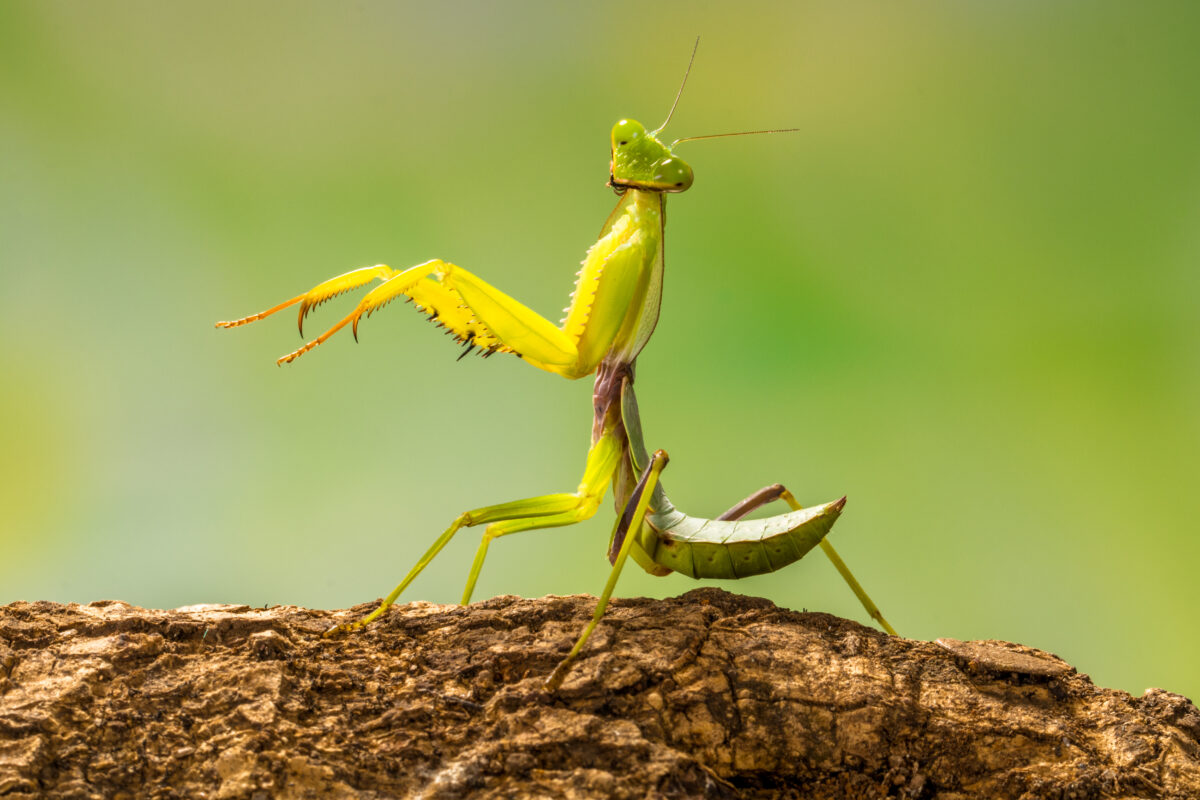
The United States is home to at least three mantis species:
The Chinese Mantis
- The Chinese Mantis can grow 5″ long, was introduced in the late 1800’s or early 1900’s to help rid crops of insects.
The European Mantis
- The European Mantis is pale green and only about half the size of the Chinese mantis.
The Carolina Mantis
- The Carolina Mantis is the only mantis species considered native to the U.S.
The Praying Mantis
The Praying Mantis gets its name from the stance they commonly adopt. The fore legs are raised as if in the act of prayer. The name mantis is derived from the Greek word for prophet. Mantis have voracious appetites and for this reason they are sometimes, incorrectly, called “Preying” Mantids.
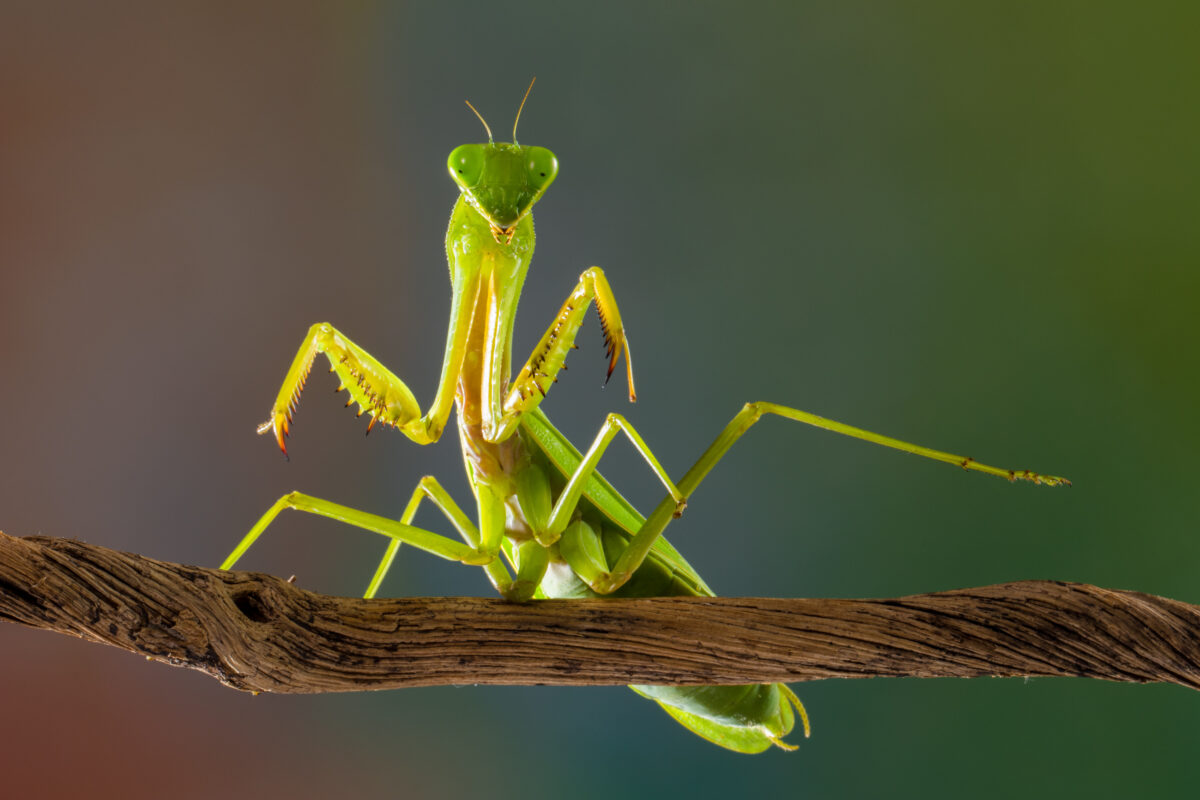
Mantis will eat prey of a similar size to themselves and bigger species will eat vertebrates including mice, lizards and frogs. Despite being predators in the insect world, praying mantes are also preyed upon. Spiders, ants, frogs, lizards, and birds are all predators of the praying mantis.
Their main defense is camouflage, blending in very well with flowers, leaves and sticks. Seeing a praying mantis can be considered good or bad luck depending on your culture.
Symbolism in Culture of the Praying Mantis
Because of the “praying” hands, some Christians say that the praying mantis represents spiritualism and if found in your home, may mean that angels are watching over you.
Some Muslims say that the praying mantis is always facing toward Mecca, Islam’s holiest city.
In Italy however, some believe that if a praying mantis looks at you menacingly, it can make you sick, and in Japan, it may even be a foretelling of your death!
In most cultures the mantis is a symbol of stillness, meditation and calming our minds. An appearance from the mantis is a message to be still, go within, meditate, get quiet and reach a place of calm.
Facts About Praying Mantis
The young nymphs that hatched look just like smaller versions of the adults. Often their first meal is one of their siblings! Nymphs eat leafhoppers, aphids or small flies.
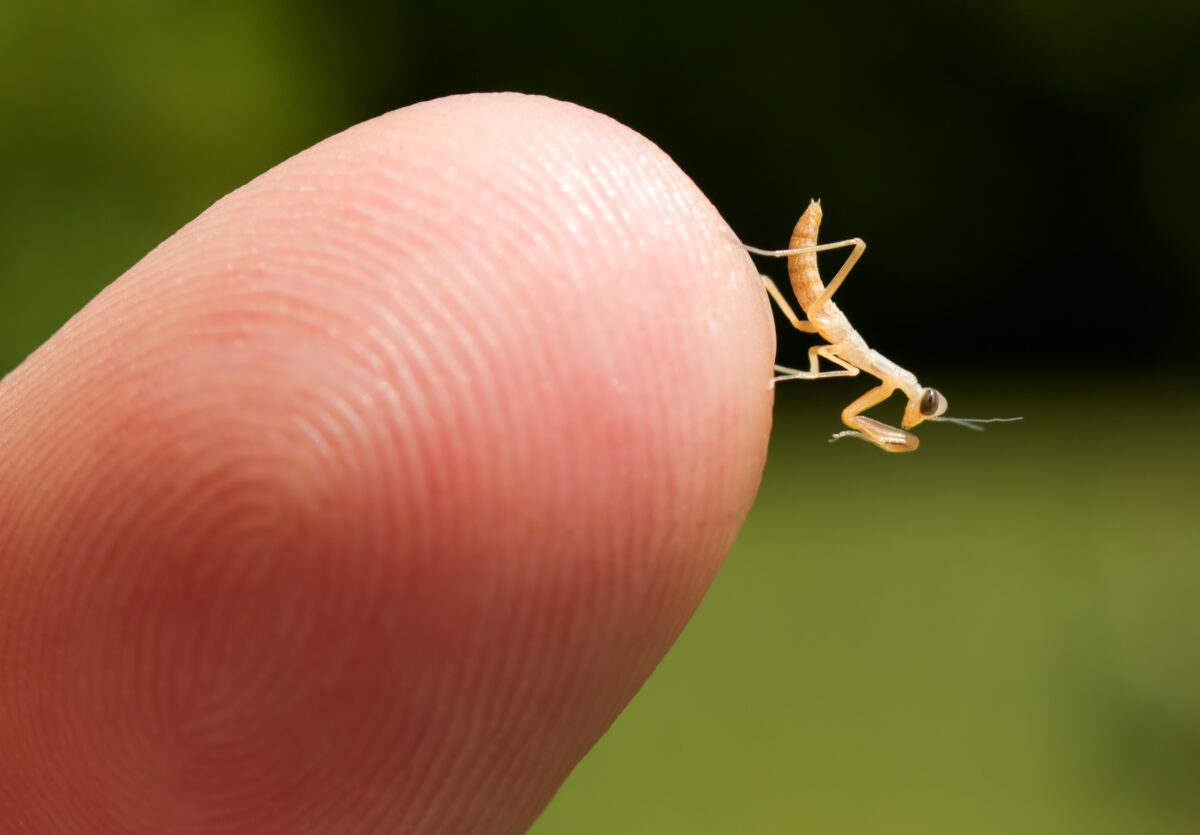
As the nymphs grow, they will periodically shed their exoskeleton, allowing the soft body tissue underneath to grow and harden into a new exoskeleton.
They will do this six to nine times before becoming an adult size. Many, but not all species of mantis will also reveal a set of wings at this final molt.
Praying mantes are killing machines! Their large raptorial front legs are covered in spines. Their huge compound eyes are mounted on a triangular shaped head, allowing for 180 degree rotation. Their forewings are leathery and stretch down the full length of their body to provide a shield of protection.
Praying mantes can live in a variety of habitats, including tropical rainforests, deserts, grasslands, meadowlands, forests, agricultural fields, and suburban gardens.
But the lifespan of a mantis is short…. barely one year!
Praying mantes are carnivores and will often hunt down smaller bugs, beetles, crickets and grasshoppers. They are masters of camouflage and once they spot a meal, they rarely miss their catch.
A Praying mantis’s pounce is strikingly fast! Their excellent binocular vision can detect movement up to 60 feet away.
Blending in with their environment they will lie in wait for their prey to get close and ambush it in about one-twentieth of a second using their spiny forearms to grasp the unsuspecting victim!
Praying mantes live a solitary life. They are also territorial and do not travel very far from their birth place. A 20 square foot area is plenty adequate as long as food is available. Often times they will hang out around light posts feeding on moths and other insects.
The intrusion of another mantis will result in a battle to the death and the loser quickly getting consumed.
The one exception is mating time…..
Praying Mantis Mating Facts
Praying mantis mate in late summer or early fall. A male Praying mantis knows to walk lightly come courtship time. He often will emit pheromones to communicate his readiness to mate.
As the male cautiously approaches the female he may perform a delicate dance, swaying or moving his antennae in a specific manner to signal his intentions. This ritual serves several purposes, including demonstrating the male’s fitness, willingness to mate, and calming the female.
It’s true that during copulation, the female may bite the head off the male….but studies reveal this to happen only 25 percent of the time! The body will actually finish the job without the head. Afterwards, the female will cannibalize her mate, further supplying nutrition to her now fertilized body.

Female of Praying mantis eating male during mating
Once her eggs are laid, her life journey is over.
Surviving male mantis that are still active in late fall or early winter will die from the first hard frost.
Praying Mantis in Chinese Culture
The mantis has long been honored in Chinese culture for its mindful movements. It is the mantis’s agility that inspired a form of kung fu called Praying Mantis Kung Fu.
Early Chinese culture saw the Praying mantis as a symbol of good fortune, prosperity, wealth, success, and large families.
In China, when a mantis was seen, people knew their crops would be successful for another year!
More Fun Facts About The Praying Mantis

- The mantis has long been honored in Chinese culture for her mindful movements. The mantis never makes a move unless she is 100% positive it is the right thing for her to do.
- The world’s largest Praying mantis was recorded to be an incredible 18 inches long, in Southern China, in 1929!
- Mantises eyes have stereo vision that allows them to see in 3-D.
- Mantises are the only insect capable of turning their head from side to side, helping them considerably with their hunting needs.
- Researchers found that females that cannibalize their male partner produced significantly more eggs than those that did not!