
How often do you find yourself working in the yard, tending your garden when a nest of ants comes spilling out of the dirt? This can be quite alarming and for many gardeners, unsettling!
Watching countless ants scatter in every direction can be a bit intimidating. Often our reaction is to reach for the ant spray and wipe out the entire colony, right?
There seems to be a common notion that ants in the yard are a problem. The reality is that ants are more beneficial in your gardens than you’d expect. Believe it or not, ants and plants have a symbiotic relationship that goes back millions of years!

Ants first appeared on the earth between 140 to 168 million years ago, during the Jurassic period. As we know, dinosaurs ruled the land during this time. Plant life thrived off of cone and spore bearing species like ferns and pines.
Ants were scarce compared to other insects. It’s believed that ants evolved from an ancient wasp ancestor. According to research and scientific theories, the species that became ants lost their wasp-origin wings and adapted to life on and under the forest floor, building nests in the ground.
As social insects, they worked together gathering food from detritus of organic material, leaf litter, and seeds from early evolving flowering plants. Stockpiles of these supplies were stored in their underground burrows for survival. For thousands of years this ant lifestyle continued until flowering plants began to spread out from the forest.
As flowering plants continued to evolve and diversify, the insects that fed on them did too. Ants became the plants’ caretakers, finding the pests an easy source of food.
As plants moved further out of the prehistoric forests, the ants followed, which helped kick off the evolution of many ant species.
Ant Diversity
Millions of years ago, Earth’s continents were clumped together into two “supercontinents“—Eurasia and Gondwana. Over time, these two supercontinents began to shift and break up into the continents we know today. As they drifted, these continents experienced climate changes.
Many things changed during the movement of the supercontinents. Migration patterns changed and geological events such as mountain building and volcanic activity forced ants to adapt.
Plant and animal species living on these moving continents either adjusted and evolved to the changes or eventually became extinct. The small but mighty ants managed to survive and thrive through these continental and climatic shifts, colonizing almost every landmass on Earth.
Ants are extremely diverse and their species include predatory hunting ants, pavement ants, carpenter ants, leaf-cutter ants, army ants, sugar ants and many, many more.
Today, scientists have identified more than 12,500 species and think that there is perhaps another 10,000 species yet to be discovered!
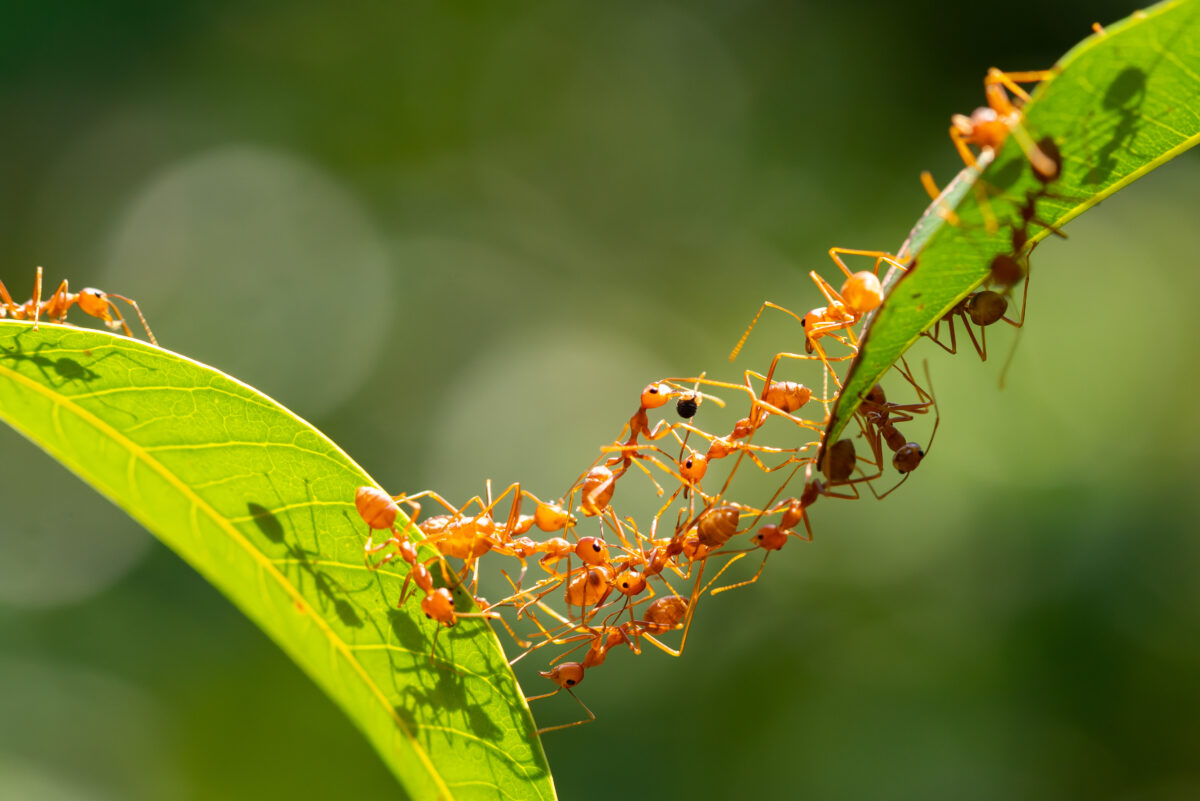
Ants and Flowering Plants
It was the diverse explosion of flowering plants that changed the ant population exponentially. The ability of plants to blossom and produce fruits around 100 million years ago provided lots of new food sources for ants.
These new plants not only provided easy food sources but new habitats as well. Over time, different ant species evolved to fill different ecological niches. Some burrowed into the forest floor, while others dwelled in the leaf litter, and still others made their nests in the treetops. Some scavenged for plant fruits, leaves, and seeds, while others preyed on pests that fed on these flowering plants.
It wasn’t long before ants became the most dominant insect on earth!
How Do Plants Benefit
Ants are one of nature’s soil aerators! By tunneling below ground they mix organic material with mineral soil, breaking down organic matter and improving soil fertility. This, in turn, adds nutrients to the soil which plant roots take up.
Flower seeds are gathered by ants and moved through tunnel systems that later germinate to become new plants.
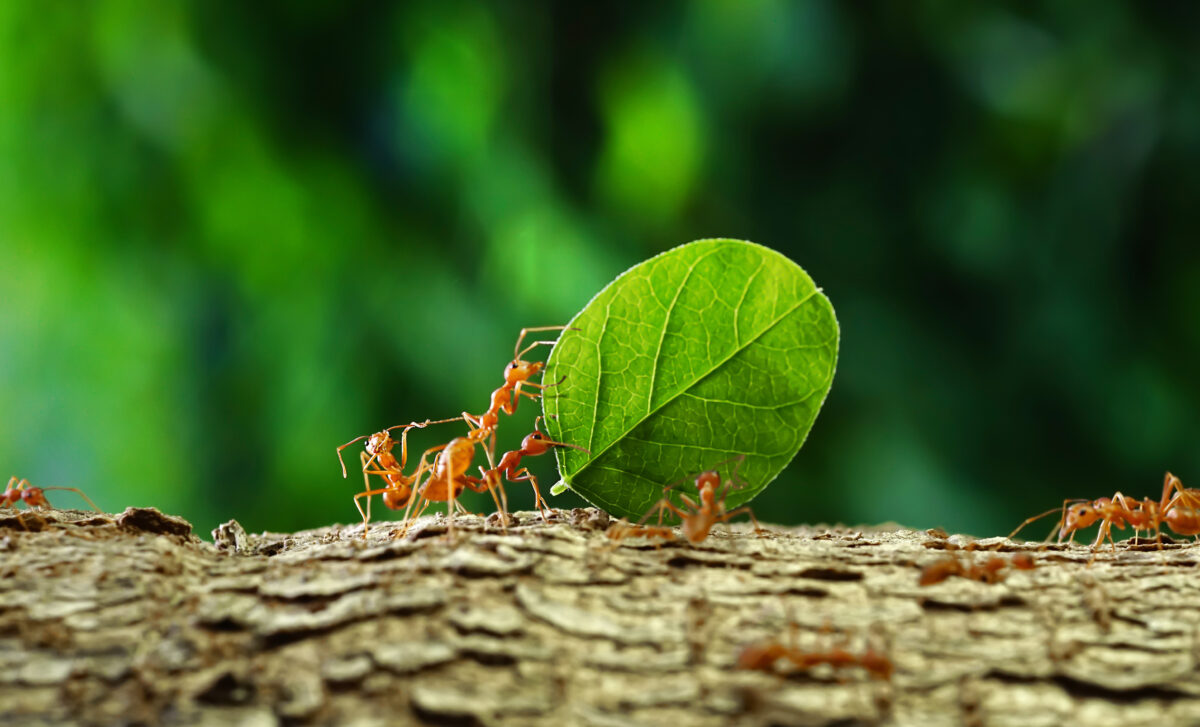
Ants are both hunters and scavengers, collecting live insects feeding on plant tissue or dead bodies waiting for consumption. They unwittingly move pollen from plant to plant, thereby assisting with fertilization.
The tunneling activities of ants loosens the soil and allows water and oxygen to reach plant roots. Plants benefit from the amino acids and urea in ant urine and feces, which can help them grow. Those little ants are doing a lot for our plant environment!
Ants in the Environment
Ants have become one of nature’s greatest success stories and are considered to be one of the most dominant social organisms on Earth. These little critters are arguably the most successful terrestrial creature.
This evolution would not have happened without the aid of flowering plants!
The presence of ants in the garden should not be one of concern, even though bugs may scare you. Ants act as decomposers by feeding on organic waste, insects or other dead animals. They help keep the environment clean.
If ants went extinct, the food chain would collapse, and it would affect every organism.
If ants go extinct many other insects, birds, and animals that rely on ants as a food source will also suffer. This would include anteaters who, as their name tells us, feed only on ants.
So what’s the secret to their success?
Their ability to adapt and diversify in response to environmental changes related to climate, geology and geography over their ancient and enduring history!
Ants are found almost everywhere on the planet. The only areas that don’t boast populations of ants are Antarctica, Greenland, Iceland, and some island nations. That’s no small feat! We don’t foresee ants going anywhere anytime soon.

FUN FACTS
* A recent study estimates there are 20 quadrillion =(20,000 trillion) individual ants across the globe, which together weigh more than all wild birds and mammals combined.
* Acacia trees reward ants with food and shelter in return for protection against herbivores.
Shelter is provided in the form of hollow spines in which ants live, and food is provided in sausage-shaped organs that grow at the tips of the leaves and are full of lipids, sugars, and proteins.
* Ants can carry 50 times their body weight, or even more. That’s the equivalent of a 200 lb human lifting 10,000 pounds!
* Ants have two stomachs, one for their own food and one for sharing with others.
* Queen ants can live for up to 30 years and have millions of babies!
-David Christopher of Agway