
Every March 17th, millions of people around the world wear their best green attire, share pints of Guinness, and join festive parades to celebrate the one and only St. Patrick’s Day. But beyond the shamrocks and lively parties, there’s a rich history that traces back over a thousand years. You know we love a good holiday history lesson here at Agway of Cape Cod! Let’s take a deeper look into the origins of this beloved holiday and explore how it transformed from a religious observance to a global celebration (to put it lightly) of Irish culture.

Who Was St. Patrick?
St. Patrick’s Day commemorates the death of St. Patrick, the patron saint of Ireland, who lived during the 5th century. Born in Roman Britain, his birth name was Maewyn Succat. At the age of 16, he was kidnapped by Irish raiders and brought to Ireland as a slave. During his six years of captivity, he worked as a shepherd and turned to Christianity for hope and strength.
After escaping and returning to his family, St. Patrick felt called to return to Ireland as a missionary. He is credited with converting much of Ireland to Christianity and using the three-leaved shamrock to explain the concept of the Holy Trinity. Legends also tell of him driving snakes out of Ireland, although scientists now attribute the lack of snakes to Ireland’s icy past rather than St. Patrick’s miracles. 😉
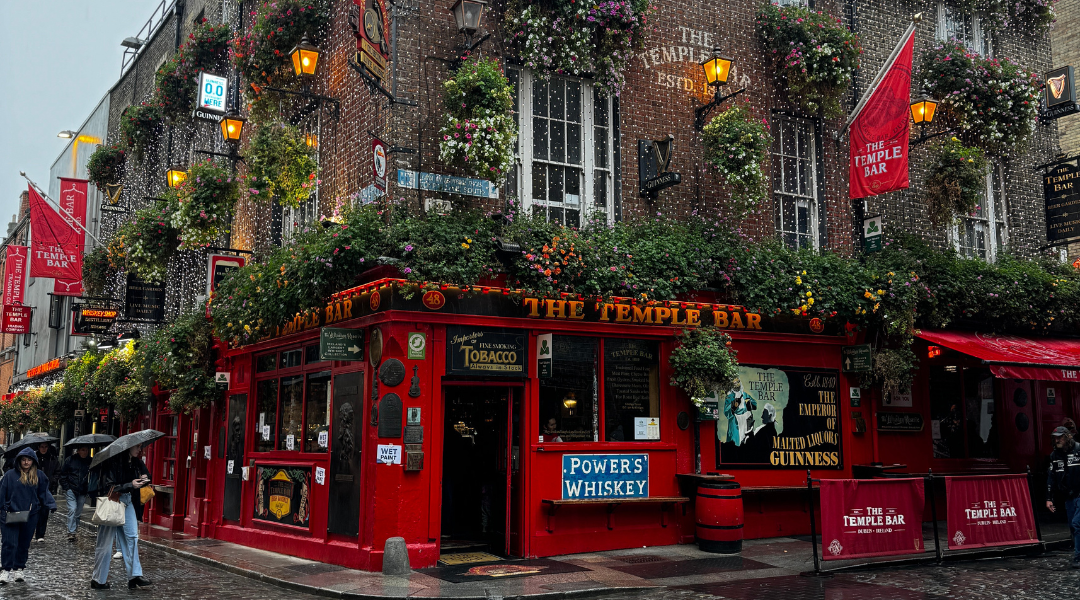
Temple Bar – Ireland
Early Observance: A Day of Reflection
Originally, St. Patrick’s Day was a religious holiday observed primarily in Ireland. Falling during Lent, it was a day for prayer, reflection, and feasting. In 1631, the Catholic Church officially recognized March 17th as a feast day, and it became a time to honor Ireland’s patron saint.
During these early celebrations, the Irish would attend church services and gather for a family meal. The food typically included dishes like bacon and cabbage, as corned beef became popular among Irish immigrants in America much later. Alcohol consumption was actually prohibited during these celebrations, as pubs remained closed in Ireland on March 17th until the 1970s. This sounds a little different than how we celebrate today, right?

Cliffs of Moher, Ireland
St. Patrick’s Day Comes to America
The transformation of St. Patrick’s Day from a somber observance to a lively celebration began with Irish immigrants in America. In the 18th century, Irish soldiers serving in the British army held the first recorded St. Patrick’s Day parade in New York City in 1762. This marked the beginning of a new tradition: public parades and social gatherings that honored Irish heritage.
As waves of Irish immigrants arrived in the United States during the Great Famine of the 1840s, they faced discrimination and poverty. St. Patrick’s Day parades became a way to showcase Irish pride and unity, helping immigrants find solidarity and support within their communities.
Global Celebrations and Modern Traditions
Over time, St. Patrick’s Day celebrations spread worldwide, and the holiday evolved into a spirited and very lively festival of Irish culture. Cities like Boston, Chicago, and New York became hubs for massive parades, music, and dancing. In Chicago, the river is famously dyed green each year, a tradition dating back to 1962. See Chicago’s infamous green river below!
Across the globe, landmarks such as the Sydney Opera House, the London Eye, and the Colosseum in Rome are illuminated with green lights in honor of the holiday. From Canada to Japan, people participate in parades, wear green clothing, and enjoy traditional Irish food and drinks.
The Symbols of St. Patrick’s Day
Certain symbols have become synonymous with St. Patrick’s Day, including:
- The Shamrock: A symbol of Ireland and St. Patrick’s teaching of the Holy Trinity
- The Color Green: Associated with Ireland’s lush landscape and nicknamed the “Emerald Isle”
- Leprechauns: Derived from Irish folklore, these mischievous fairies symbolize luck and fortune
- Irish Music and Dance: From Irish Dancers to fun routines, traditional music and dancing are integral to the celebrations
St. Patrick’s Day Today: A Celebration of Heritage
Today, St. Patrick’s Day is celebrated by people of all backgrounds around the world, embracing the festive spirit and sense of community it creates. In Ireland, it has become a multi-day festival with music, food, and cultural exhibitions. In the United States and beyond, parades and parties are at the heart of the festivities.

While the holiday’s religious roots remain significant to many, St. Patrick’s Day has transformed into a joyous celebration of Irish culture and global unity. It’s a day to remember the resilience and spirit of the Irish people, while also embracing fun traditions and community spirit.
So, whether you’re raising a glass of green beer, enjoying a traditional meal, or sporting your finest green attire (don’t forget to wear green!), take a moment to reflect on the fascinating history behind St. Patrick’s Day. It’s a story of faith, tradition, and the enduring spirit of the Irish.