
By Agway’s own, David Christopher.
In the early years of the 1840’s, in a region of Toluca Valley, just west of Mexico City, a tiny unknown spore hitched a ride on a wild potato and floated to a nearby farm.
There it found its way to the farmer’s potato field and quickly settled on a single potato leaf. Turning the leaf dark green, then brown then producing black spots, it spread along the surface down to the stem.

Toluca Valley, Mexico
Where water or dew collected on the edges and tips of the leaves, sporangiophores appeared turning the leaf white on the lower surface of the foliage and developing into a mold. Each sporangiophore (much like an egg sac) would produce up to one thousand new spores.
The new spores are quickly released and travel by rain and wind onto new potato leaves in the field. Virtually overnight, the farmers field is blanketed with diseased plants, annihilating his crop.
The mold that developed from this single spore grew, multiplied and spread from one farmer’s field to another. It would soon become the greatest and most destructive farming disaster in history.
This tiny spore was unknowingly about to have a global impact on the farming industry, making history and changing the thinking of science forever!
The Journey North
Still new and untamed, this ‘water mold’ continued northward through Mexico and crossed the border into the U.S.

By the summer of 1843, spores, carried by wind, were showing up on the potato farms of Eastern United States. For the next 2 years this water mold, now recognized as a late blight, spread its infection further north and into Canada.
Late blight is not like other potato or tomato diseases. Most other plant diseases might only affect the leaves or cause minor damage to the fruit or vegetable, but late blight will completely ruin an entire crop!
Now given a scientific name, phytophthora infestans, it translates to mean ‘plant destroyer’.
The disease reproduces quickly….. especially at night when the temperature rests between 60-75°F degrees, and leaves are wet from rain, dew, or fog. Rain can wash spores into the soil where they infect young tubers.
The outbreak can continue to spread as spores release short-lived, one-celled, flagellated zoospores that can swim through thin films of water on leaf surfaces or in water filled soil pockets.
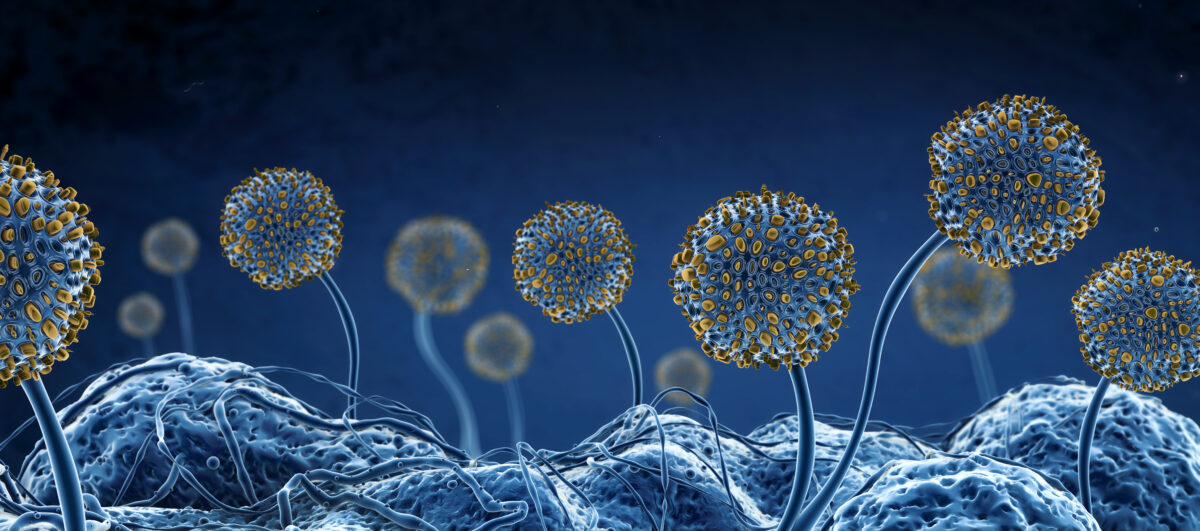
Microscopic image of growing molds or mold fungus and spores
On top of that, the wind continues to carry new spores several miles to new hunting grounds.
The early stages of late blight can be easily missed. Symptoms include the appearance of dark blotches on leaf tips and plant stems. White mold will appear under the leaves in humid conditions soon encompassing the entire plant. Infected tubers develop grey or dark patches that are reddish brown beneath the skin, and quickly decay to become a foul smelling mush.
Under ideal conditions, phytophthora infestans completes its life cycle on potato foliage in about five days!
A Cold Blooded Killer Emerges
In 1845, a ship loaded with potatoes departed an eastern port of the U.S., setting its sails for Belgium. Unknowingly, spores of phytophthora had found their way to the potatoes and were now on route to European shores.
Landing in Belgium, the fungus resurrected and reproduced, destroying potato crops in Normandy, Holland, Flanders and southern England. By mid-August 1845, the blight had reached much of northern and central Europe.
In the year 1840, potatoes were the most common crop in Ireland, taking up as much as twenty-five percent of cropland in some counties.
Potatoes were easy to grow in Irish soil, nutritious, and calorie rich. Potatoes could grow very well in rocky soil and took up little space. Just one acre of potatoes could feed a family of four for up to one year.
Having ravished its way through much of Europe, winds from southern England then carried the fungus to the countryside around Dublin. There it thrived in the unusually cool and moist weather of the summer.

Dublin, Ireland
The mold found more potato crops and developed new spores on leaves. Rains washed spores into the soil to infect growing roots, and by late 1845, between one-third and one-half of Ireland’s potato fields had been infected and destroyed.
By 1846, the lack of sustainable potatoes created a food crisis never before encountered.
For the next four years, Ireland endured a nightmare of hunger and disease that for some generations, still carries anger and resentment to this day.
Political Controversy
Ireland during this time period was under English rule. Throughout the entire period of the Famine, Ireland was exporting enormous quantities of food to England. Around 75% of Irish soil was devoted to wheat, oats, barley and other crops that were grown for export and shipped abroad. All this was being sent to England while the people of Ireland continued to starve!
During 1847, one of the worst years of the famine, upwards of 4,000 ships carried food from Ireland to the ports of Bristol, Glasgow, Liverpool and London. The food was shipped under military guard to prevent looting and uprising. That year, 400,000 Irish men, women and children died of starvation and related diseases!
Besides grains, a wide variety of other commodities left Ireland in 1847. This included beans, onions, peas, herring, salmon, oysters, honey, animal skins, lard, tongues, shoes, rags, glue, soap and seeds.
It’s also recorded that 822,681 gallons of butter was exported to England during the nine months of the worst year of the Famine. Irelands population of about 8.5 million became decimated!

Potato Famine Memorial – Ireland
It is estimated that about 1 million deaths occurred between 1845 and 1851 due to starvation or hunger related diseases. Another 1 million Irish people left their homeland to live in Great Britain, Canada and the United States.
This meant that Ireland lost a quarter of its population during those dreadful years. The Famine’s impact was most severe in the west of Ireland where some counties lost more than 50% of their population!
The “famine” ended in 1849, when British troops stopped removing the food and ended the exports.
It would be another two years of lingering death’s and families moving abroad before food stocks stabilized and the famine was officially over.
Potato Blight Today
Phytophthora infestans is a highly adaptable and virulent pathogen that has eluded human efforts to combat it for over 150 years. It wasn’t until the early 20th century that improvements in crop breeding yielded potato varieties that proved resistant to Phytophthora infestans. But it’s not over!
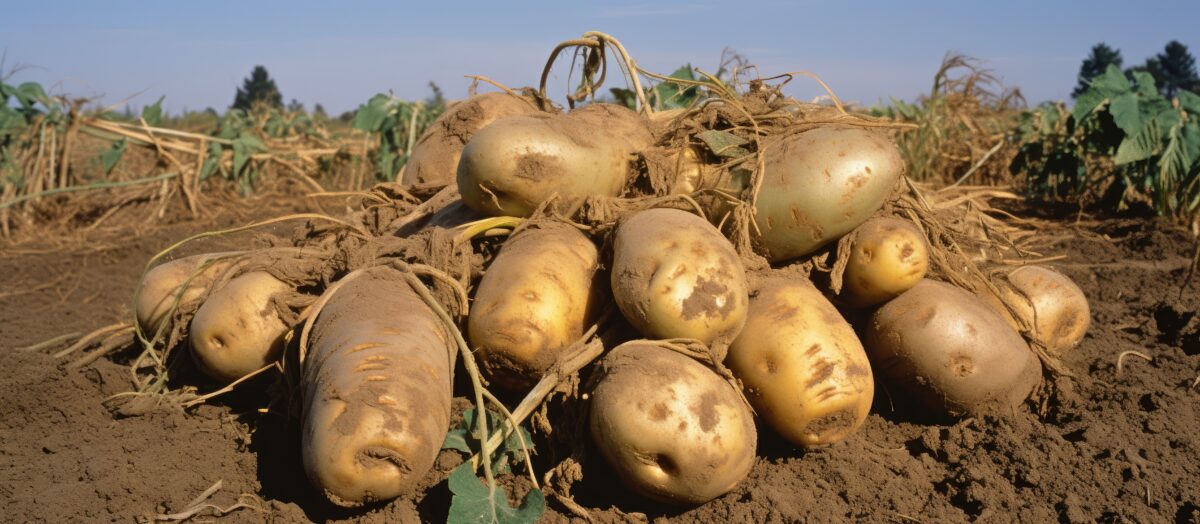
As of February 2024, Phytophthora infestans still is a threat to global food security. It’s estimated that over six billion dollars a year is spent globally to control future outbreaks.
Fungicides are most commonly used to combat the pathogen, but they can be expensive, have negative environmental impacts, and can lead to the emergence of resistant strains. Unfortunately, most attempts to control it have been unsuccessful.
The pathogen can spread in many ways, including through airborne spores, seeds, soil contamination, infected potato tubers and water transport. It can also evade control strategies like fungicides and chemicals.
On top of that, the spores of Phytophthora infestans are thick walled and able to persist in the soil for several years, making the disease difficult to eradicate.
Some researchers suggest that the same wild potato species where its thought the mold originated may also be the answer and source of disease resistance.
In addition, scientists have made some progress in understanding the pathogen’s molecular profile and continue developing management strategies that may someday render this water mold gone forever!
The More You Know
It’s important to know the history of different significant historical events around the world so that we can understand what caused them. It’s crazy to think that one of the worst events in Ireland (that we still talk about today!) was caused by a fungus that originated outside of Mexico City. Keep an eye on your potatoes and let’s be thankful for the bountiful produce that we have available to us today.